

Original Words by Stephen Revere
What is Banchan?
Don’t let the main course distract your attention from all the delicious side dishes on the table!
Original words by the chef Ciaran Hickey
The Korean Meal Will Always Come With Side Dishes
For me the single biggest difference between Western and Korean mealtimes has to be the array of Korean side dishes presented with every meal. These small plates, Banchan, can range from three to whatever number the table will hold.
The important thing to know is that the side dishes are to be shared by the whole table and restaurants will refill them for you, and they should be finished by the end of the meal.
Granted, some places will just put out some tired, salty kimchi and a few other weird dishes that even Koreans just pick at. They’re probably in a fancy building in Gangnam-gu and pay too much for their rent, so they make up for it by dropping food quality.
But around the corner there’s sure to be a dive in an older building that will serve up four to six of the beauties below for the same price or less. You can tell whether you’ve found one by the fact that it’s crowded. Another good tip: more items on the menu likely means lower quality. Find a restaurant with under five items on the menu, and you’ve likely found one of the best restaurants in the gu (구, district).
Some Korean side dishes are braised or simmered dishes of meat that are served cold. Of these I really enjoy Jangjorim.
We make it with beef brisket simmered in a light broth with soy and served with quails eggs cooked in the same broth. The brown colored quail’s eggs were a surprise to me but I have grown to love them, the only drawback being they are a nightmare to pick up with chopsticks.
There are a few Korean words you need to know for meals that revolve around banchan and therefore must serve up some good ones: baekban (백반) and bapsang (밥상). Baekban is a cheap, basic Korean meal that will have up to a half dozen banchan along with a bowl of rice and a little soup. Koreans will complain that it’s just like the food their mom makes, while I rejoice as I love this healthy food that I’m too busy to make myself. And if you see the word bapsang, then it probably means there will be a lot more banchan with the meal, up to 20 or more in smaller portions. Another occasion for one to rejoice.
Types of Banchan
Banchan are generally split into categories according to the cooking process, here are a few of my favorites:
Kimchi – Of the fermented foods, Kimchi is the king. It’s unusual to see a Korean meal without this side dish. While the cabbage version is the stable and the most common, the white radish, Ggakdugi is my absolute favorite. You will recognize this as it is cut in easy to pick up cubes, and it’s crunch and spice making it so popular.
Salted and Fermented Squid (오징어젓갈 ojingeo jeotgal)
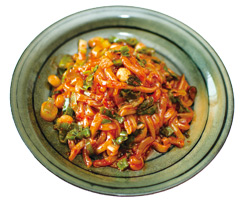
From planting their potted kimchi in the ground to freeze-drying their fish and vegetables, Koreans have traditionally been absolute artists when it comes to food preservation. This marinated and heavily salted squid will virtually last forever, but have some rice ready before diggin’ in, and avoid it if you have high blood pressure.
Dried Radish(무말랭이 mumallaengi)

Who knew that if you sliced radish up into thin strips and let it dry out it would turn into a totally different taste? Usually purchased already dried from the store, after a little boiling up and seasoning this ultra-crunchy banchan has a tad of sweetness added to the obvious spice.
Simmered Potato (감자조림 gamja jorim)
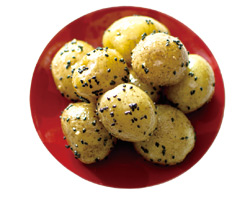
Potatoes may be expensive here, but that doesn’t seem to stop restaurateurs from serving them. The mixture of soy sauce, corn syrup and/or sugar topped with a little sesame oil and sesame seeds makes for a delicious but unique potato flavor, different from the usual sour cream and butter.
Pickled Perilla Leaf (깻잎절임 kkaenip jeorim)
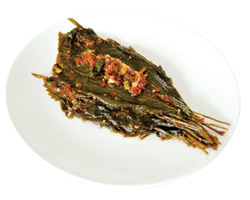
A rare find in the rest of the world, you’re quite likely to find the soy sauce and red pepper-marinated version on your dinner table here. Shock Koreans by telling them that it’s not actually sesame leaf but perilla, a plant from the mint family. Then enjoy its fresh, apple-mint flavor.
Tofu (두부 dubu)
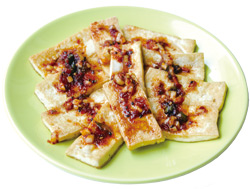
There’s a reason women get less breast cancer in Asia, and it’s called tofu (check here). Okay, it’s not quite that simple, but it’s a huge factor. And when they panfry it then sprinkle some soy sauce seasoned with green onions and sesame oil on top of your tofu, eating healthy tastes great too.
Bean Sprouts (콩나물 kong namul)
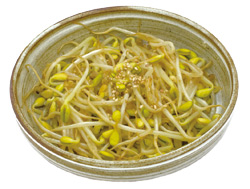
Everywhere I go there is a new one to try. I really like Kong-Namul, bean sprouts blanched and tossed in sesame oil. Spinach leaves in garlic is also another one of my favorites. I learned how to make both of these on my on a Korean Cuisine cooking class last year. Being that they are cheap, healthy, delicious and easy to prepare, it’s easy to see why this is a nearly ubiquitous banchan. Boil the sprouts up, mix with garlic, soy sauce and other seasonings, sprinkle with some sesame seeds and voila! The customers love it and free refills don’t hurt a bit.
Lotus Root (연근 yeongeun)
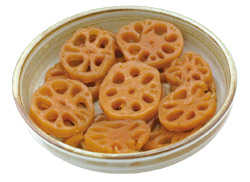
A personal favorite. You’re in for a treat if you’ve never had lotus root before. This Swiss cheese-looking root can run the gamut of flavors and textures, from crispy to mushy or salty to sweet, depending on how long it’s cooked or how much soy sauce and corn syrup they used in the sauce.
Leafy Greens (나물 namul)
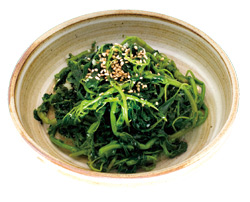
What does the doctor always tell you to eat? Leafy greens. Namul – Vegetables, herbs and roots that have been cooked, marinated and served cold are referred to as “Namul”. I have learned that this term covers an absolute multitude of varieties as each region and even town has its own local versions. That’s what namul are, though the term applies to a slightly wider variety of plant life, including some things that aren’t green. Suffice it to say that when veggies are blanched or pan-fried and then seasoned they are often referred to as namul.
Napa Cabbage Kimchi (배추김치 baechu kimchi)
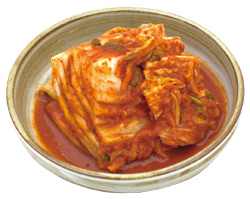
On the off chance you haven’t tried kimchi, do. And then do again and again. The first time it may be a little off-putting, but as with most great flavors it’s an acquired taste. That wonderful smell when they open the fridge—that’s just the fermentation process making itself known.
Whole Radish Kimchi (총각김치 chonggak kimchi)
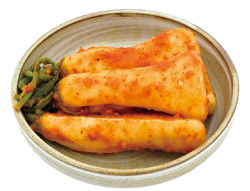
The Napa cabbage version of kimchi is of course the stuff of world renown, but the radish forms are no less delicious. “Bachelor kimchi”—so-called because the green shoots at the end resemble the ponytail of bachelors in the Joseon-dynasty—is spicy and salty like regular kimchi but the Korean radish it’s made with gives it a pungent kick.
Stir-fried Eggplant (가지볶음 gaji bokkeum)
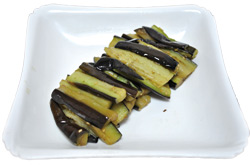
Italians, rejoice! You can get plenty of eggplant here and it’s delicious, although it’s usually the Japanese variety, which is more narrow and cylindrical than fat and egg-shaped. Its shape leads to a more typical thick, julienned cut when they sauté it, leaving more skin on it.
Stir-fried Anchovies (멸치볶음 myeolchi bokkeum)
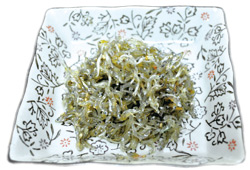
Anchovies are the perfect way to add a little saltiness to whatever you’re eating, and with polyunsaturated fish oil, plenty of vitamin E and D, and minerals like calcium and selenium, they’re like crunching your way through your daily multi.
Zucchini Jeon (호박전 hobakjeon)
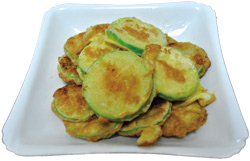
Who doesn’t like pan-fried veggies? Jeon (전) is pretty much egg-battered and deep-fried anything. The wonderful little Korean Pancakes that everyone loves are also part of the Banchan dynasty. They come in a multitude of pretty colors and are great for taking the edge off the heat of some of their neighbors on the table. They are very useful also for picking up small pieces of pork belly and Kimchi to make mini sandwiches.Often the best Korean chefs (read “mom”) will batter and fry up cod, mushrooms and tofu in this way, but the most common kind is usually hobak—zucchini. For more on jeon, see our Taste of Korea article.
Egg Roll (계란말이 gyeranmari)
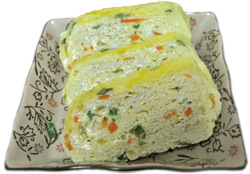
Egg is gyeran (계란), and mari (말이) means rolled up, so gyeranmari is rolled-up eggs. An egg and veggie mixture is poured into a pan and then after it’s cooked a bit it’s rolled up into a cylindrical shape. Gotta love it when this shows up.
Stir-fried Fish Cake (오뎅볶음 odeng bokkeum)

Fish pancake, fish hotdog, fish donuts—whatever you call it, odeng sautéed up with a little onion, green onion or carrots is a delicious little side dish. Of course, since it’s ground fish paste mixed with flour and deep fried, it’s not necessarily the healthiest of the dishes on your table.
Small cooked dishes called “Bokkeum” are among some of the surprises. It’s always a lottery as to what you will get and I spent a lot of early time here asking repeatedly, What’s in that one there? Anything with pork belly is always fine with me but I do tend to steer clear of the dishes with more personality, like octopus or anchovy.
So everything from Tofu to dried anchovies and marinated fish intestines, to coleslaw style salads make the sheer diversity of Banchan so interesting, you just have to find your own favorites.
Remember: it’s not poor etiquette to skewer a quail’s egg after 12 attempts to pick it up with chopsticks!
Want to know more about the Korean Cuisine? Check out the 11 Popular Korean Foods








2 comments
lynnwei_lee
Hi, may I know what’s the difference between baekban and jeongsik? As both serve a variety of banchan with rice…
Or does baekban not come with a main dish like jeongsik?
Tasting Korea
Baekban can refer to cooked white rice or a course that includes white rice, soup, and several side dishes. Jeongsik refers to a fixed set of courses served at a restaurant. Baekban can be a form of jeongsik.