

What is the Working Holiday Visa in Korea (H1)?
The South Korea Working Holiday Visa, also known as the H-1 visa is designed for people who want to discover South Korea while financing their travel and living expenses by working small-time jobs. With a Working Holiday Visa in Korea, you can stay up to 12 months within the country (more for US and U.K.) and you are free to travel to other countries and come back since it is a multiple entry visa.
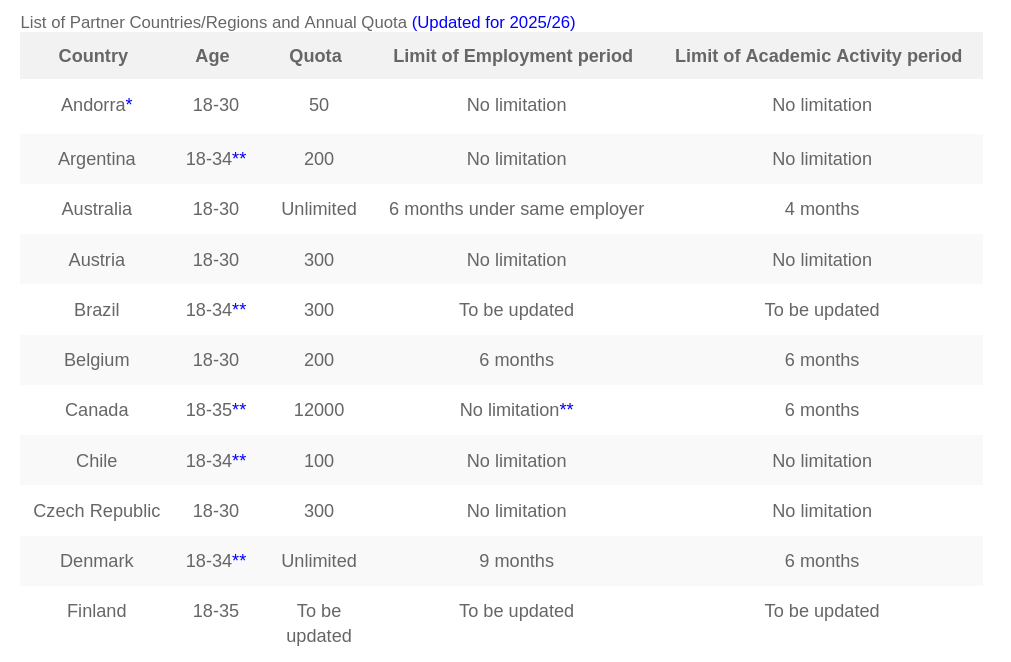
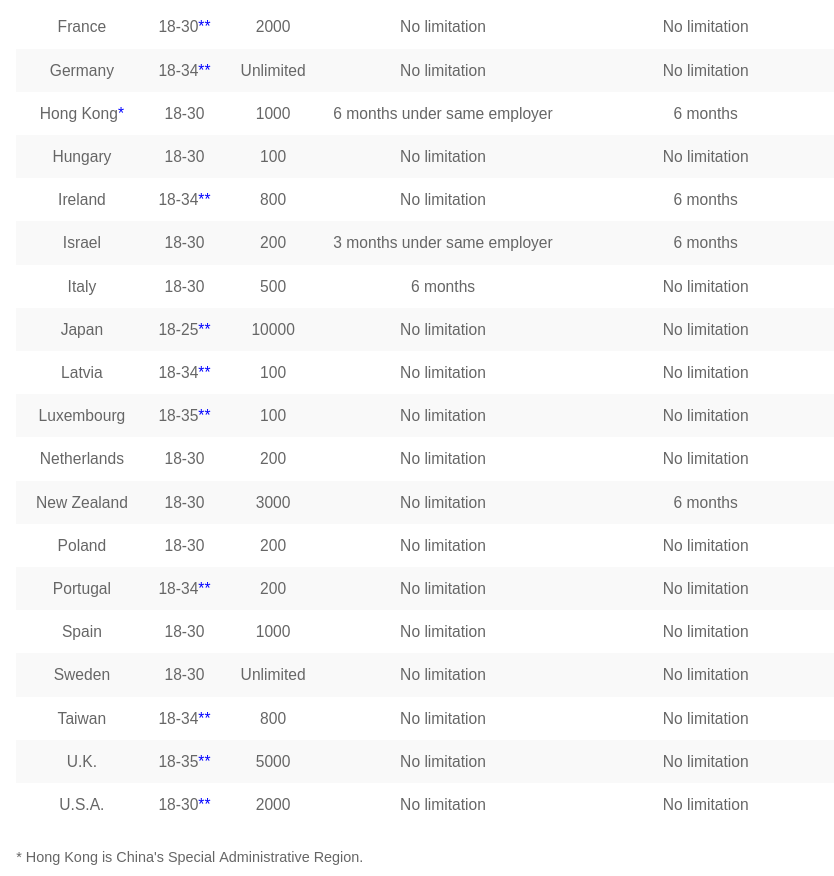
Korea now has bilateral Working Holiday agreements with 30 countries/regions. Finland signed an agreement with Korea on 13 May 2026, bringing the total from 29 to 30.
What are the requirements to be able to apply for a working holiday?
To be able to apply, there are some criteria you have to fit, such as:
- Be between 18–30 years old in most cases, noting that many countries now have higher upper limits (up to 34 or 35). Check the age limit specific to your nationality in the table above or on the WHIC website.
- Have a passport valid for at least 1 year.
- Be able to give financial proof that you can support yourself financially during the first stage of your Working Holiday in Korea. This means you need a bank statement showing at least KRW 3,000,000 in savings.
- Have a return flight ticket or proof of funds that you can buy one.
- Have special insurance covering your Working Holiday period.
- Be traveling to Korea for the sole purpose of holiday and travel.
- Submit your travel plans (see below).
- Pay the application fee usually in cash(if there is one).
Those requirements are susceptible to change according to your nationality so be sure to check your country’s Korean embassy to get the appropriate information.
How to apply for the Working Holiday in Korea?
The next step is to prepare all the paperwork, you will find the list of the needed documents on your country’s Korean embassy website. You might need a medical check-up, fill out online documents like an e-visa form, and a criminal record check.
2 documents everyone has to procure are “travel plans” and a Certificate of Health Insurance covering the length of your stay.
Travel Plan
The “travel plan” is a simple document where you write your motivation, your objective, and the plan of your travel with a timetable in chronological order. Depending on the embassy, you can download forms to fill in, but otherwise, here is a template form to give you an idea of what is expected from you.
Working Holiday Insurance
Another requirement is the insurance certificate. There are some special insurances made especially for Working Holiday applicants since there are requirements on the coverage. They require a 1-year insurance contract covering civil liability, repatriation, and all the risks linked to disease, maternity, disability, and hospitalization, with a coverage minimum of 40,000,000 won. A quick search on Google will allow you to find an insurance policy fitted to your needs.
Be aware, that your insurance may not refund bills if the hospital paperwork and pharmacy bills are in Korean, and finding a proper translator can be expensive. Make sure you read the insurance contract or call the insurance company before subscribing to clear this point up.
Application process
Once you have collected all the documents, you should make an appointment at your local embassy. You are only able to apply for the visa in person in your country of residence. The processing time can take 5 to 14 working days depending on your embassy. Check your embassy website as it may differ. During the appointment, they will give you a paper with the time when to pick up your passport.
*If you live far from the embassy and cannot easily visit in person, contact your country’s Korean embassy to ask whether you can submit your application and receive your visa by mail.*
Finally, received your Working Holiday visa? You have a limited time to enter the country. However, this is different per country. This could be 1 month, 3 months, or even up to a year starting from the issuance date. Pay attention, if you arrive too late your visa could be canceled.
What should you prepare before coming to Korea?
Learning Korean
It is now time to prepare for maybe the best year of your life, and there is one recommendation to make: learn Korean. If you don’t have the time to learn before leaving, at least learn how to read Hangeul and download one of these apps. The H-1 visa permits study at private educational institutions (private language academies / hakwon) and university Korean language schools (어학당), but not regular university degree courses (which require a D-2 student visa) as the WHIC official brochure (2026–27) specifically states. The allowed period for language study may also vary depending on the bilateral MOU between Korea and the applicant’s home country.
You might be wondering why do you need to learn Korean, especially if you have already come for holidays. Yes, you can manage to live pretty easily in Korea without speaking a single word of the language, but that’s very different when it comes to working. Most of the jobs available for foreigners require at least a basic or intermediate level of Korean, even as a waiter/waitress. Of course, you can find jobs that do not need Korean, so don’t feel discouraged, there are still opportunities for you!
What types of work can you do with a Working Holiday Visa in Korea?
H-1 visa holders can do most temporary, unskilled work. Common permitted roles include cafes, restaurants, hotels, retail, childcare, event staffing, and seasonal farm work. You can find the full list of allowed jobs here.
You cannot work as: language instructors, doctors, lawyers, professors, pilots, licensed cooks, professional/technical staff, or paid private tutors. Paid English tutoring in particular can result in deportation and a 5-year entry ban.
Most nationalities are limited to 25 hours per week (Canadians: up to 40 hrs). Some countries also cap total working months or time with one employer — check your specific rules before signing a contract. The 2026 minimum wage is 10,320 KRW/hour; you are legally entitled to this regardless of your nationality.
What do you have to do when you arrive in Korea?
Alien Registration Card (officially renamed Residence Card “RC” in 2021)
Within 90 days of arrival, you must register at your local Korea Immigration Office to get your Residence Card (RC), still often called the ARC. The correct office is based on your registered home address, not your workplace. You can check the required documents (passport, photo, rental contract, etc.) on HiKorea and read our separate guide for more details.
Make an online appointment as early as possible – there is often about a one‑month wait. The fee is 35,000 KRW, paid by Government Revenue Stamp (수입인지) at the immigration office or a partner bank. You can fill out the form on-site or download it in advance. Processing usually takes around 4 weeks.
Since January 2025, RCs include an IC chip, and you can also get a free Mobile Residence Card via the Mobile IDentification app if you have a postpaid Korean SIM in your name. The mobile card has the same legal effect as the physical one for most everyday situations.
Important: after you apply, you generally cannot leave Korea until your RC is issued. If you need to travel before receiving the physical card, you can show your temporary registration certificate at immigration when departing or re‑entering Korea.
Change of address
If you move apartments during your Working Holiday in Korea, you are required to inform authorities within 14 days (weekends included). You can do this at your local gu office (e.g., if you live in Yongsan-gu, go to the Yongsan-gu office), the Korea Immigration Office, or your dong community center (e.g., if you live in Yeoksam-dong, go to the Yeoksam-dong community center). Book your appointment on the HiKorea website. If you fail to declare your new address within 14 days, you will only be able to go to the Korea Immigration Office and may face a fine. You can also now complete an address change online via e-application on the official HiKorea website, making it more convenient if you cannot attend in person.
Korean National Health Insurance
After six months in Korea, H‑1 holders are automatically enrolled in National Health Insurance (NHI) and will receive a bill at their registered address. If you already have valid Working Holiday insurance that meets the Korean requirements, you can visit an NHIS office and request an exemption so you are not paying for two policies at the same time.
To apply, bring your Residence Card, passport, and a translated copy of your private insurance policy to the NHIS Center for Foreign Residents (Sindorim) or another NHIS branch. You can also call 033‑811‑2000 or 1577‑1000 (press 7 for foreign languages) for help before you visit. Some nationalities (for example, certain EU countries) may have additional exemptions based on bilateral agreements, so it is worth asking about this in person.
NHI does not replace the Working Holiday insurance you used to get your visa, so make sure that private policy remains valid for your full stay.
For the latest details, check the official NHIS English site at nhis.or.kr/english.
How to change visas after the working holiday period is over?
Once your Working Holiday period ends – or if you receive a full‑time job offer earlier – you may want to switch to another visa. Whether you can change from H‑1 to E‑7 (Foreign National of Special Ability Visa) inside Korea depends on your nationality and job offer.
Some nationalities can usually apply for an in‑country change from H‑1 to E‑7 at a Korean immigration office if they meet all E‑7 requirements, including a qualifying full‑time job and salary. Others must leave Korea, apply for the E‑7 at a Korean embassy or consulate in their home country, and then re‑enter on the new visa.
For other visa types (such as language study, university, or teaching), the rules differ by country and visa category. The safest approach is to call the Korea Immigration Contact Center at 1345 or check immigration.go.kr for the latest information before making any plans.
Now that you know everything there is to know about the Working Holiday Visa in Korea, what is left for you is just to enjoy this year to the fullest and make amazing memories.
Don’t forget to tag 10mag Instagram in your most beautiful landscape photos and 10magfood in your delicious food pictures.







6 comments
Simon
Hey! What happens if you don’t actually work on a WHV in South Korea?
We were just debating this topic
Laura Beaty
Not a lawyer, but can’t imagine you HAVE to work. Many people go months in between jobs or travel around Korea during that time. Interesting question though!
Elías M
As far as I know you can just not work if you want. But it’s kind of senseless because almost all (if not all) of those countries allow to travel to Korea without any visa (for tourism purposes). So if somebody wants to get all that bunch of documents without the intention of looking for a job, it’s his/her choice I guess.
Christine
Hello! This is a helpful article and a great read!
However, I’ve noticed possible discrepancies between this article and the US Embassy of Korea website:
1)This article says that you have 1 month from the start of visa issuance. However, on the US Embassy of Korea website, it says you have 12 months from issuance to enter Korea.
2)This article names a certificate of Health Insurance as a requirement for obtaining this visa for all applicants despite their resident country, but this isn’t mentioned on the US Korean embassy’s website under the required documents for this application process.
It isn’t at all my intention to pick apart this article. I’m simply trying to acquire the most accurate information possible before beginning the application process myself; I don’t want to risk my application being rejected because of false understanding. I’ve found myself relying on online research and articles like these to get some of my questions answered since my local Korean embassy is hard to contact and difficult to understand over the phone.
If anyone could clear any of this up for me, I would deeply, deeply appreciate it.
Thanks
Elías M
As far as I know you can just not work if you want. But it’s kind of senseless because almost all (if not all) of those countries allow to travel to Korea without any visa (for tourism purposes). So if somebody wants to get all that bunch of documents without the intention of looking for a job, it’s his/her choice I guess.
Stephane
Hello,
I was told twice that a French person holding a H-1 visa cannot change to E7 visa in Korea under the agreement between the two countries but I can’t find any information about this rule anywhere online. Is that correct?
Thank you for your help!