
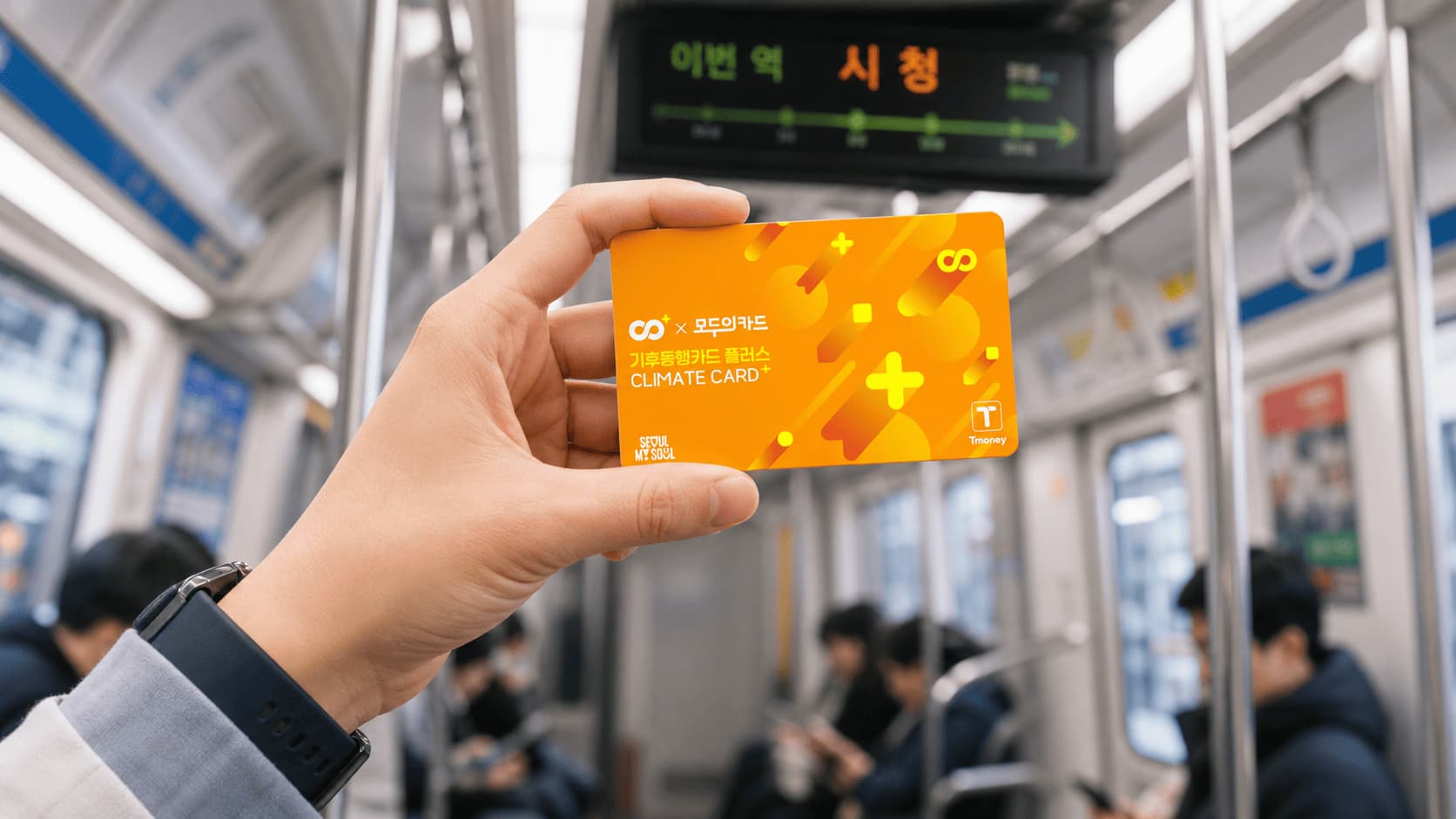

South Korea runs one of the most efficient, densely connected public transit networks on Earth, but 2026 has brought a genuinely confusing shake-up to how residents and visitors pay for it. Seoul’s flagship 30-day unlimited Climate Card (기후동행카드), launched in January 2024, is being phased out and merged into the national government’s K-Pass (케이패스) cashback system, rebranded as “Climate Card Plus” (기후동행카드 플러스). For expats, international students, and tourists trying to plan their commute or their next Seoul trip, the terminology alone — Climate Card, Climate Card Plus, K-Pass, “모두의 카드” (Everyone’s Card) — can be genuinely disorienting. This guide breaks down exactly what changed, who is affected, and what foreign residents and short-term visitors should actually do to keep saving money on transit.
What was the Seoul Climate Card?
The Seoul Climate Card was a prepaid, flat-rate unlimited pass where you pay a fixed amount upfront (₩62,000 for 30 days) and ride Seoul subways, city buses, and Ttareungi bikes as many times as you like, with no cap on trips.
What is K-Pass?
K-Pass, launched nationally by the Ministry of Land, Infrastructure and Transport, works differently. It is a postpaid cashback (mileage refund) program where users pay normal fares with a registered K-Pass card, and after taking at least 15 trips in a month, they get a percentage of their spending refunded the following month.
Because the two systems overlapped in purpose but worked on opposite payment logic, the government and Seoul City decided to merge them rather than let citizens keep guessing which was more cost-effective. The result, Climate Card Plus, automatically calculates each month whether the refund model or the flat-rate model saves the user more money, and applies whichever is better.
| Feature | Old Climate Card (기후동행카드) | K-Pass / Climate Card Plus (2026) |
|---|---|---|
| Coverage area | Seoul subway, city/village buses, Ttareungi, Hangang Bus (Seoul only) | Nationwide — metropolitan subway, red intercity (광역) buses, GTX, expanding regional lines |
| Pricing model | Prepaid flat-rate unlimited (30-day pass ₩62,000) | Postpaid tiered cashback (20%/30%/53%) on actual spending, PLUS a new flat-rate “Plus” option (₩100,000/month) for GTX & express buses |
| Requirement | None — open to anyone with a T-money-type card | Requires a linked bank credit/debit card, K-Pass app registration, and (for locals) resident verification |
| Target user | Anyone riding heavily within Seoul, including tourists on short-term passes | Korean residents and ARC holders commuting regularly, especially cross-border Seoul–Gyeonggi–Incheon commuters |
| Refund threshold | N/A (flat fee, no minimum rides) | Minimum 15 trips/month to qualify for any cashback |
| Short-term tourist option | 1/2/3/5/7-day passes | Same short-term passes retained, unaffected by the merger |
Key takeaway: The old monthly (30-day) Climate Card is being discontinued. Recharge stops on July 31, 2026, and the card stops working entirely after August 29, 2026. Existing 30-day Climate Card users must get a new Climate Card Plus card while existing K-Pass users don’t need to do anything, as the integrated benefits apply automatically.

What K-Pass Means for Foreign Residents (ARC Holders)
Foreign residents holding an Alien Registration Card (ARC), including international students, working professionals, and long-term expats, can register for K-Pass, and the national rollout actually expands their benefits, since K-Pass covers metropolitan lines, red (광역) intercity buses, and GTX express trains connecting Seoul to Gyeonggi-do and Incheon, unlike the Seoul-only Climate Card. This is particularly valuable for cross-boundary commuters who live outside Seoul but work or study inside the city.
Step-by-Step Registration Guide
- Get a participating card: Apply for a K-Pass-linked credit, debit, or prepaid card through one of the roughly 20+ participating banks/card issuers (Shinhan, KB Kookmin, Woori, Hana, NH Nonghyup, Samsung, BC, IBK, K-Bank, and others).
- Receive the physical or mobile card: Cards can be issued as physical Tmoney-enabled cards or via the Mobile Tmoney app (Android + iOS) starting July 1, 2026.
- Download the K-Pass app or visit korea-pass.kr: Register as a member using the card number.
- Verify identity with a Korean mobile number: This step requires an active Korean phone plan, which most ARC holders already have.
- Enter your Alien Registration Number (외국인등록번호): This links the ARC to the residence address, which auto-verifies eligibility for regional add-ons like Incheon I-PASS or Gyeonggi Pass.
- Register a bank account for refunds: Cashback is either deposited into a linked account or deducted from the next card statement, depending on the card issuer.
- Start riding and tracking trips in the app: Cashback is not automatic without this registration step — simply tapping a T-money card without app registration does NOT qualify for any refund.
Tip: Some foreign residents have reported banks (e.g., Shinhan) initially declining online applications for foreigners, so it’s worth applying in person at a branch or via the K-Pass hotline if the app rejects your ARC number.
How to Get Cashback (Partial Refund)
K-Pass refund tiers for 2026 are: 20% standard (ages 35+), 30% youth (ages 19–34), and 53% low-income (basic livelihood recipients/near-poverty households); multi-child households and seniors receive 30% as well. Notably, a temporary boosted-refund period ran April–September 2026, raising youth refunds to 45% and low-income refunds to as high as 83% to offset high fuel/fare costs, before reverting to standard rates in October. As of 2026, the previous cap of 60 refundable trips per month has also been removed, so frequent transfer users no longer lose out on refunds past a certain trip count. International students under 35 with an ARC should confirm youth-tier status is auto-applied based on the birthdate on file with the card issuer. No separate certification is normally required.
Under the merged Climate Card Plus system, if monthly spending is below ₩62,000, the K-Pass refund model kicks in (20%/30%/53% back); if spending exceeds ₩62,000, the system instead treats it like the old flat-rate Climate Card and caps the cost at ₩62,000 for unlimited Seoul rides that month, plus a new ₩100,000 “Plus” flat-rate option extends unlimited access to GTX and 광역 buses. This dual-mode design means ARC holders effectively get the best of both systems without having to choose.
Important: Seoul officials have also flagged that discount and refund benefits under Climate Card Plus specifically will be limited to registered Seoul residents, whereas the old Climate Card had no residency restriction. Foreign residents registered outside Seoul (e.g., Incheon, Gyeonggi) should instead look at parallel regional programs like the Incheon I-PASS or Gyeonggi Pass, which mirror K-Pass’s ARC-based registration process.

What This Means for Tourists & Short-Term Travelers
Short-term visitors on tourist visas cannot register for K-Pass under any version of the system. K-Pass requires a Korean bank-issued credit/debit card, a Korean mobile phone number for identity verification, and, for regional add-ons, an Alien Registration Number tied to a residence address, none of which a tourist typically has. K-Pass’s core mechanic also assumes ongoing monthly commuting (minimum 15 trips) with cashback paid the following month, a structure that doesn’t fit a trip lasting days, not months.
What is a Climate Card pass?
The encouraging news for tourists: Seoul explicitly preserved the short-term Climate Card passes (1, 2, 3, 5, and 7 days) through the K-Pass merger, precisely because Seoul officials noted that roughly 60–70% of short-term pass buyers are foreign tourists. These passes remain available at the same 2026 pricing:
| Pass Duration | Price (KRW) | Best For |
|---|---|---|
| 1-Day | ₩5,000 | A single packed sightseeing day |
| 2-Day | ₩8,000 | Weekend visits |
| 3-Day | ₩10,000 | Most popular short-stay option |
| 5-Day | ₩15,000 | Week-plus itineraries |
| 7-Day | ₩20,000 | Full week in Seoul |
A ₩3,000 physical card fee applies separately, and since March 2026 these short-term passes can be purchased with international credit cards at station kiosks, easing a longstanding pain point for foreign visitors. Given the base subway/bus fare of roughly ₩1,400–1,550, break-even is reached at about 3–4 rides per day.
Note: Short-term Climate Card passes do not include Ttareungi bike-share or the Hangang river bus, and they explicitly exclude AREX airport rail and intercity/airport buses.
Alternative Options for Tourists
- T-money card: A simple pay-per-ride prepaid card, sold with foreign-tourist versions (around ₩15,000 including deposit and service fee), usable nationwide including outside Seoul.
- WOWPASS: An all-in-one prepaid card exclusively for foreigners that combines currency exchange, cashless shopping payments, and a built-in T-money transit function, issued at airport and city kiosks via passport scan, and works well for travelers who also want to avoid separate cash exchange.
- Discover Seoul Pass: A sightseeing pass (not primarily transit-focused) offering free admission to 70+ attractions, sometimes bundled with the Seoul Climate Card via travel platforms like Klook for non-Korean passport holders.
- Standard single-ride T-money/EZL top-ups: Best for travelers taking fewer than 3–4 rides a day, when a multi-day flat-rate pass wouldn’t break even.
Comparison & Decision Checklist
Use this quick checklist to decide which card fits a specific situation:
- Staying 1–7 days as a tourist, riding often → Buy a short-term Climate Card pass matching trip length.
- Staying under a week, riding occasionally (1–2 trips/day) → Use T-money or WOWPASS pay-per-ride instead; a flat pass won’t pay off.
- Want to also pay for shopping/food cashlessly and exchange currency → Get WOWPASS instead of plain T-money.
- Living in Korea long-term with an ARC, commuting daily within Seoul → Register for K-Pass / Climate Card Plus; refund or flat-rate mode applies automatically.
- ARC holder commuting between Seoul and Gyeonggi/Incheon (GTX, 광역 buses) → K-Pass Plus flat-rate (₩100,000) or standard cashback tier is essential, since the old Climate Card never covered these routes.
- Full-time student or under-35 ARC holder → Confirm youth 30% cashback tier is applied at registration for maximum savings.
- Low-income or multi-child household with ARC/resident status → Apply for the 53% refund tier, the highest available.
The core shift is simple even if the branding is messy: Seoul’s old prepaid, flat-rate Climate Card is disappearing by September 2026, replaced by a merged system (Climate Card Plus, built on the national K-Pass) that automatically picks the cheaper of a cashback or flat-rate model for residents. Foreign residents with an ARC gain expanded, nationwide coverage and tiered cashback, but must actively register a linked bank card through the K-Pass app. Tourists are unaffected in the way that matters most, as the short-term 1–7-day Climate Card passes tourists actually use continue exactly as before.
FAQ
Can I apply for K-Pass with a tourist visa?
No. K-Pass requires a Korean bank-issued card, a Korean mobile number for verification, and, for full regional benefits, an Alien Registration Number, none of which tourist-visa holders have. Tourists should use short-term Climate Card passes, T-money, or WOWPASS instead.
Does K-Pass cover the Airport Express (AREX) or KTX?
No. K-Pass refunds apply to standard urban and metropolitan transit such as subways, city/village buses, and red intercity (광역) buses, but explicitly exclude KTX, taxis, and intercity/express services, and these trips don’t count toward the 15-ride monthly minimum either. The Climate Card similarly never covered AREX outbound from the airport.
What happens to my physical Climate Card if I already have one?
Monthly (30-day) Climate Card holders who recharge by July 31, 2026 at the latest, can use the remaining balance through August 29, 2026, and must then obtain a new Climate Card Plus card, since the old card stops working entirely from September 1, 2026. Anyone already using K-Pass does not need a new card, as the merged benefits apply automatically to the existing K-Pass card. Tourist short-term (1–7 day) passes are unaffected by any of these changes.