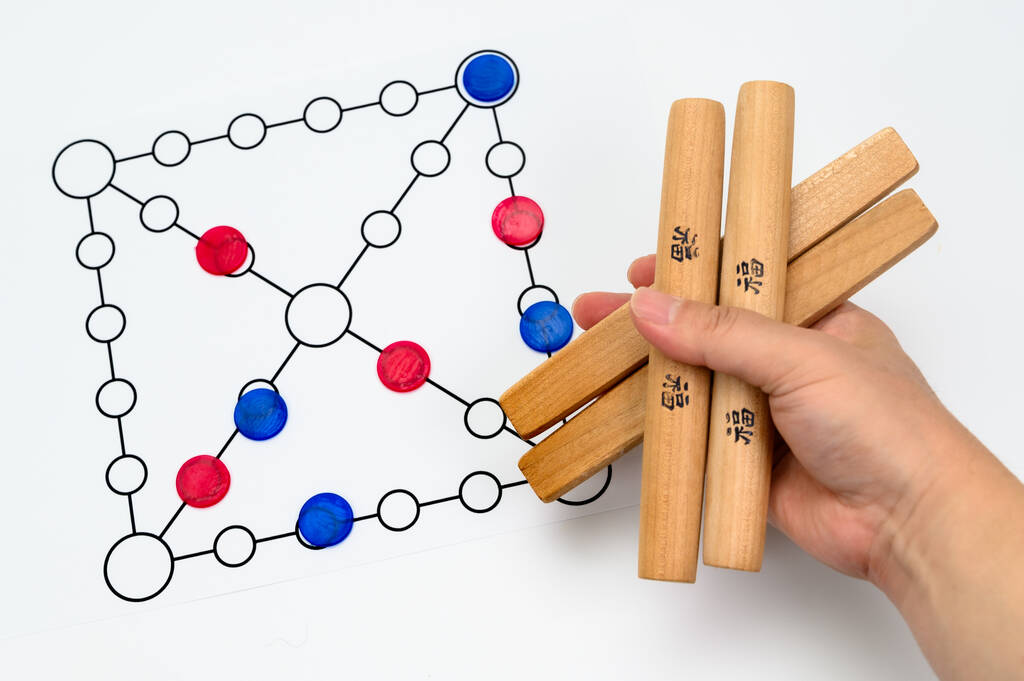

Yutnori (in Korean: 윷놀이) or yunnori is Korea’s classic holiday board game: four wooden sticks, a simple drawn board, and enough luck and strategy to keep an entire family shouting at the floor. Most Koreans connect it with Seollal: the Korean Lunar New Year, but the game is easy to learn and still works beyond holiday gatherings.
What Is Yutnori (윷놀이)?
Yutnori is a traditional Korean board game played by two people or teams who toss four wooden sticks and move tokens around a cross-and-circle board. Instead of dice, the flat and rounded sides of the sticks decide how far each token moves, and the first team to bring all of its pieces home wins.
The game has a long history in Korea, with records from the Goryeo and Joseon periods describing Yutnori history, its 29 stations, and its links to astronomy and seasonal rituals. Today, it is recognized as a form of National Intangible Cultural Heritage in Korea, reflecting both its symbolism and its continued popularity.
The Board’s Cosmic Meaning
The Yut Nori board isn’t just a game path, it’s an ancient star map. The 28 outer stations represent the 28 constellations of traditional East Asian astronomy, while the center point marks the North Star. Moving tokens counterclockwise mirrors how the Big Dipper rotates around the North Star through the seasons. The four sticks, with one flat side and one rounded side, symbolize Yin and Yang.
From Fortune-Telling to Family Game
Historically, Yutnori was played on the first full moon of the Lunar New Year (Jeongwol Daeboreum) as a communal divination ritual part of a rich tradition of Korean Lunar New Year customs and superstitions that shaped how Koreans celebrated the season. Villagers divided into teams (like Mountain vs. Plains) to predict which region would have the best harvest. The winning team’s side was predicted to have abundant crops that year. Today, that ritual meaning has evolved into the family-friendly game we play during Seollal.
How to Play Yutnori | Yutnori Rules
Board, sticks, and tokens
- Board (malpan, 말판): Traditionally embroidered on cloth or drawn in the dirt, the yutnori board is a circle-and-cross layout with 29 stations, including outer spaces and inner shortcuts. Modern yutnori sets often use a rectangular board with the same paths and corner/center junctions.
- Sticks (yut, 윷): Four half-cylindrical sticks with one flat side and one rounded side are tossed into the air each turn. The way they land determines how far you move, which is why people looking up yutnori rules or how to play yutnori usually start with the sticks.
- Tokens (mal, 말): Each team usually has four tokens. They can be anything easily distinguished by color or shape, from plastic markers and coins to buttons or small stones.
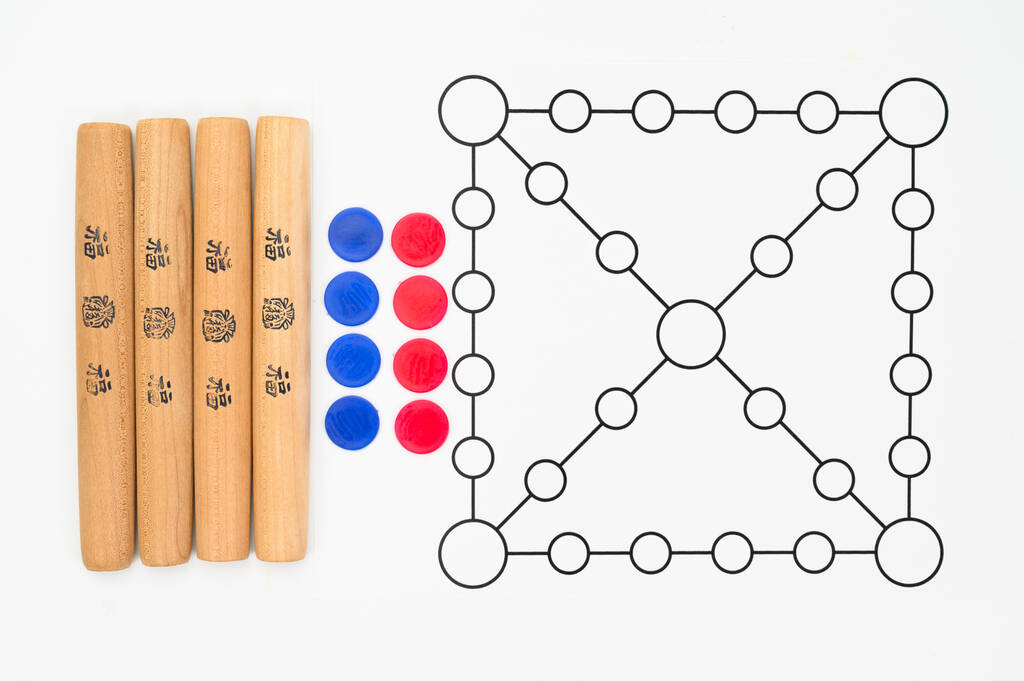
You only need three things: a board, four sticks, and four tokens per team. If you’re looking for a yutnori game set, that’s all it contains. The board usually shows an outer loop and inner diagonals, and it can be printed, drawn on paper, or even scratched into the ground.
On your turn, toss the four sticks and count how many land flat-side up. Each result has an animal name:
- Do (도) = pig; 1 flat side up = move 1 space.
- Gae (개) = dog; 2 flat sides up = move 2 spaces.
- Geol (걸) = sheep; 3 flat sides up = move 3 spaces.
- Yut (윷) = cow; 4 flat sides up = move 4 spaces and throw again.
- Mo (모) = horse; all rounded sides up = move 5 spaces and throw again.
Step-by-Step: How to Play Yutnori
- Decide who goes first by each side throwing once. The team with the higher result starts.
- On your turn, toss all four sticks in front of you.
- Count how many flat sides land facing up to get Do, Gae, Geol, Yut, or Mo.
- Choose one token to move that many spaces, or bring a new token onto the board when allowed.
- If you land on a corner or the center point, follow the shortcut path on your next move.
- If you land on an opponent’s token, send it back to the start. If you land on your own, you can stack them and move them together.
- When you throw Yut or Mo, move and then throw again. Keep taking extra turns until you no longer get Yut or Mo.
- The first team to bring all four tokens home wins the game
Many people also play with Back Do (뒷도), a special one-flat-stick result that forces you to move one space backwards. Tokens normally travel counter-clockwise around the outer route, but landing on a corner or the center lets you cut across a diagonal shortcut. If you land on an opponent, their token goes back to the start; if you land on your own, the pieces stack and move together, which is faster but riskier if they get captured. The first team to send all four tokens home wins.
Why Koreans Still Play Yutnori
Yutnori game works because it is simple, social, and just strategic enough. Children can learn the rules in a single practice round, but adults still argue over whether to stack pieces, take the shortcut, or keep tokens spread out across the board. The heavy role of luck means grandparents and kids genuinely have a chance to beat each other, which keeps the mood light.
At the same time, the board’s cosmic symbolism, the seasonal associations with the New Year, and the livestock names for each throw give the game a uniquely Korean flavour. Playing Yutnori is not just killing time between courses, it ties a modern living room back to older ideas about fortune, harvest, and the turning of the year.
If you enjoy traditional Korean experiences, explore more hands‑on Korean activities and cultural workshops !
Yutnori and Board Games in Korea Today
In a country full of PC bangs and mobile games, Yutnori game still appears every Seollal, at school culture days, in board game cafes and in local festivals, showcasing traditional games. You can also find browser and mobile versions of 윷놀이 온라인, plus seasonal events where Yutnori sits alongside modern titles in board game cafes.
For international players, that makes Yutnori a perfect bridge between “board game Korea” searches and real Korean culture: it’s easy to learn, requires almost no equipment, and doesn’t feel like homework.
Korean perspective
For many Koreans, Yutnori (윷놀이) is less a game they learned from a rulebook and more something tied to holidays, classrooms, and family gatherings. Some first played it in elementary school after a teacher explained the rules, while others mostly watched older relatives play during Seollal and picked up the game intuitively over time. What makes it feel especially Korean is not just the sticks and board, but the little tensions built into the rules: the rare Back Do that sends you backward at the worst possible moment, the Nak rule when a throw lands outside the mat, and the way a lucky Mo can suddenly change the mood of the whole room.
Even among Koreans, the game can mean slightly different things: for some, it belongs to big holiday gatherings; for others, it was something they also played casually with parents or friends on ordinary days. But the common thread is that Yutnori still feels simple, social, and unmistakably traditional, whether it is played on a living-room floor, in a classroom, or 동물들과 윷놀이 Yutnori online. In one line, it is a game that blends luck, strategy, and nostalgia in a way that still makes sense to new players today.
Words by Yuhyun, Inkwon, and Minsoo Lee, Native Koreans colleagues and friends interviewed by the author.
How to Try Yutnori Yourself
If you’re in Korea, look for inexpensive Yutnori sets in supermarkets, stationery shops, traditional markets, or museum gift stores, especially in the weeks before the Lunar New Year. Outside Korea, you can download a printable board, tape chopsticks together for sticks, and use coins or buttons as tokens, enough to turn your next game night into a Korean holiday floor.
For more seasonal traditions and folk games, see great things to do during Chuseok in Korea !
If you find this article helpful, you can leave a comment below! Also, check out our article on Night Markets In Seoul You Should Stay Up For and Camping and Glamping in Korea !