
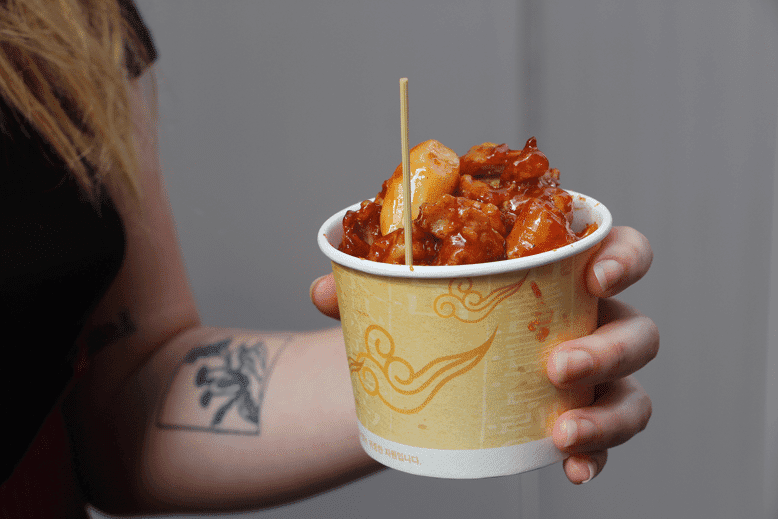
Korean street food is cheap, fast, and made to eat standing up. Most snacks cost ₩2,000–₩6,000, only a handful are truly fiery, and the best places to graze in Seoul are Gwangjang Market, Myeongdong and Namdaemun Market. Below are 25 dishes worth knowing: what each tastes like, what it costs, and where to find it.
Savory Classics
Tteokbokki (떡볶이)
Say it: dduk-bo-kee · Price: ₩4,000–₩6,000 a plate; ₩5,000–₩7,000 in Myeongdong· Where: any market stall; Sindang-dong for the sit-down version
Finger-thick rice cakes simmered in gochujang (fermented chili paste), sugar and stock, usually with fish cake and a boiled egg. Expect sweetness first, slow-building heat and a dense, bouncy chew. You eat it standing at the counter, with a toothpick.
Insider tip: Order tteok-twi-sun (떡튀순): tteokbokki, twigim and soondae on one plate, all in the same sauce.
Eomuk (어묵)
Say it: aw-mook; also odeng (오뎅), from Japanese oden · Price: ₩1,000–₩2,000 a skewer · Where: every tteokbokki stall; Busan for the best
White fish paste is pressed into thin sheets, folded onto long skewers and simmered in radish-and-anchovy broth until soft, springy and savory rather than fishy. Pull a skewer from the pot and ladle broth into a paper cup; the broth is usually free.
Insider tip: Keep your empty skewers. Vendors count them to work out what you owe.

Gimbap and Mayak Gimbap (김밥, 마약김밥)
Say it: keem-bap; ma-yak keem-bap · Price: ₩3,000–₩5,000 a roll; ₩4,000–₩6,000 a plate of mayak gimbap · Where: gimbap shops everywhere; Gwangjang Market for mayak gimbap
Gimbap is sesame-oiled rice rolled in gim (dried seaweed) around egg, vegetables, ham or fish cake, then sliced. Mayak gimbap is Gwangjang’s finger-sized version; mayak means “narcotic,” a joke about how hard it is to stop. Eat it by hand or with chopsticks, dipping mayak gimbap in sharp mustard-soy sauce.
Insider tip: For a vegetarian roll, ask haem, eomuk ppae-juseyo (햄, 어묵 빼주세요): no ham, no fish cake.
Mandu (만두)
Say it: mahn-doo · Price: ₩4,000–₩7,000 a portion · Where: Namdaemun Market; steamer stacks outside snack shops
Dumplings filled with pork, tofu, glass noodles, and vegetables (gogi mandu) or tangy kimchi (kimchi mandu). Steamed wang mandu (“king dumplings”) are fist-sized and fluffy; pan-fried ones are thin and crisp-bottomed. Dip them in soy sauce with vinegar and chili flakes.
Insider tip: Order banban (반반), half and half, to try both. Kimchi mandu usually contain pork too.
Tteok-kkochi and Sotteok-sotteok (떡꼬치, 소떡소떡)
Say it: dduk-ggo-chee; so-dduk-so-dduk · Price: ₩2,000–₩3,000 and ₩3,000–₩5,000 · Where: stalls near schools; Myeongdong; highway rest stops
Tteok-kkochi is a skewer of rice cakes, fried until blistered and brushed with sticky sweet-chili glaze. Sotteok-sotteok alternates rice cakes with cocktail sausages: one chewy bite, then one snappy and salty. Eat it hot, before the glaze sets.
Insider tip: Koreans link sotteok-sotteok with road trips because highway rest stops (hyugeso, 휴게소) are famous for it.
Dakkochi (닭꼬치)
Say it: dahk-ggo-chee · Price: ₩3,000–₩6,000 a skewer · Where: Myeongdong, Hongdae, pojangmacha
Chicken thigh and green onion are grilled on a flat-top or over charcoal and glazed as they cook: soy-garlic, original or spicy, which can be properly hot. Eat it off the stick; the paper sleeve catches drips.
Insider tip: Unsure about heat? Ask for an maepge (안 맵게), “not spicy.”
Fried Favorites
Korean Fried Chicken (치킨, 닭강정)
Say it: chee-keen; dahk-gahng-jung · Price: ₩5,000–₩8,000 a cup of dakgangjeong; ₩20,000–₩28,000 a whole chicken · Where: Hongdae, markets, neighborhood chicken shops
Korea didn’t invent fried chicken, but it built a distinct style. Double-frying renders out fat and leaves a thin, crackly shell that stays crisp under sauce, such as a sticky yangnyeom (양념) glaze of gochujang, garlic, and syrup, or soy-garlic. On the street, it’s dakgangjeong: glazed bite-size pieces in a paper cup, eaten with a toothpick.
Insider tip: In the evening, pair a whole chicken with beer. That’s chimaek (치맥), from chikin plus maekju, beer.

Korean Corn Dog (핫도그)
Say it: hat-do-geu · Price: ₩3,000–₩5,000 · Where: Myeongdong, Hongdae, chain shops near subway exits
Koreans call it a hot dog; most visitors see a corn dog, though the batter is a thick wheat or rice-flour dough. Inside is sausage, mozzarella or half of each, under panko or diced potato. It’s rolled in sugar and striped with ketchup and mustard, and the cheese pulls a long way.
Insider tip: To skip the sugar, say seoltang ppae-juseyo (설탕 빼주세요) before they roll it.
Tornado Potato (회오리 감자)
Say it: hweh-oh-ree gahm-ja · Price: ₩4,000–₩6,000 · Where: Myeongdong, Hongdae, festivals
A whole potato is cut into one long spiral, fanned along a skewer, deep-fried and dusted with cheese, onion or honey-butter powder. The edges turn chip-crisp; the center stays soft. Eat it from the top down, one loop at a time.
Insider tip: Share one. It fills you up fast, and a street-food crawl is about variety.

For Adventurous Eaters
Soondae (순대)
Say it: soon-deh (sundae in Revised Romanization; no relation to ice cream) · Price: ₩4,000–₩8,000 a plate · Where: Gwangjang Market, tteokbokki stalls; Sillim-dong Sundae Town for the stir-fried version
Pork intestine casing stuffed with dangmyeon (glass noodles) and pig’s blood, steamed, sliced and usually served with liver and lung. It’s milder than it sounds: soft, savory and slightly earthy, with a springy chew. Dip each slice in the salt-and-pepper mix on the side.
Insider tip: Skip the offal by saying naejang ppae-juseyo (내장 빼주세요).
Beondegi (번데기)
Say it: bun-deh-gee · Price: ₩3,000–₩5,000 a cup · Where: traditional markets, river parks, fairground carts
Boiled or steamed silkworm pupae, seasoned and served in a paper cup with a toothpick. Each gives a small pop, then a soft, nutty, earthy center. For most first-timers, the smell is a bigger hurdle than the taste.
Insider tip: Taste one from a friend’s cup first. Convenience stores sell canned beondegi if you’re hooked.
Sweet Treats
Hotteok (호떡) and Busan’s Ssiat Hotteok (씨앗호떡)
Say it: ho-dduk; shee-aht ho-dduk · Price: ₩1,500–₩3,000; up to ₩4,000 in Myeongdong · Where: Namdaemun, Insadong, Myeongdong; BIFF Square in Busan for ssiat hotteok
Yeasted dough filled with brown sugar, cinnamon and nuts, pressed flat on an oiled griddle until crisp outside and molten inside. Busan’s ssiat hotteok is fried, split and packed with sunflower and pumpkin seeds. It’s handed over folded in a paper cup.
Insider tip: Bite the edge first; the syrup burns. At Namdaemun, try savory yachae hotteok (야채호떡), stuffed with glass noodles and vegetables.
Gyeranppang (계란빵)
Say it: gyeh-rahn-ppahng · Price: ₩2,000–₩3,000 · Where: Myeongdong; carts near subway exits in cold months
A small, lightly sweet bread baked in a mold with a whole egg on top: soft and buttery below, set and salty above. Eat it from the paper bag while hot, like a portable breakfast.
Insider tip: Commuters buy it on cold mornings, so subway-exit carts are often the freshest.
Dalgona (달고나)
Say it: dahl-go-nah; also ppopgi (뽑기) · Price: ₩2,000–₩5,000 · Where: Insadong, Ikseon-dong, some markets
Sugar melted with a pinch of baking soda, pressed flat and stamped with a shape. It tastes like burnt-sugar honeycomb and shatters easily; Squid Game (2021) made the cut-out challenge famous. Pick around the shape with a needle.
Insider tip: A few vendors let you make your own. It takes minutes and beats a pre-made one.
Winter Specials
Look for these from roughly November to February, near subway exits and bus stops.
Bungeoppang (붕어빵)
Say it: boong-uh-ppahng · Price: commonly 3 for ₩2,000, or ₩1,000 each in central Seoul · Where: carts near subway exits; some convenience stores
A fish-shaped pastry baked in a hinged iron mold, similar to Japanese taiyaki, with a crisp edge, soft middle and red bean (pat) or custard filling. Ingeoppang (잉어빵) is a thinner, crisper variant. Red bean wholesale prices nearly doubled between 2023 and 2025, Hankyung reported, which is why ₩1,000-a-fish stalls are now common. Eat it hot, head or tail first.
Insider tip: Stalls come and go; Koreans find them with crowdsourced map apps such as Gaseumsok 3-cheonwon (가슴속 3천원)

Hoppang (호빵)
Say it: ho-ppahng · Price: ₩1,500–₩2,500 · Where: convenience stores, in steamer cases by the counter
Technically a convenience-store snack, hoppang is a soft, slightly sweet steamed bun that returns every autumn, filled with red bean, pizza, vegetables or meat. Peel off the paper base and eat it right away, before it dries out.
Insider tip: Some stores let you take one with tongs and pay at the counter; elsewhere, ask the clerk.
Gun-goguma and Gunbam (군고구마, 군밤)
Say it: goon-go-goo-mah; goon-bahm · Price: ₩3,000–₩5,000 a bag · Where: winter street carts; convenience stores for gun-goguma
Both often come from the same drum-oven cart. Sweet potatoes are either bam-goguma, dry and chestnut-like, or hobak-goguma, soft and almost jammy, with caramelized skins. Chestnuts are scored, roasted and handed over warm in a paper bag; peel as you walk.
Insider tip: Convenience chains such as CU sell roasted sweet potatoes from heated cabinets when carts are scarce.
Where to Find the Best Street Food in Seoul
Go to Gwangjang Market for traditional dishes and Myeongdong for evening grazing. Seoul’s street food comes from carts, market food alleys and pojangmacha (포장마차): covered street stalls under plastic tarps, many of which become casual drinking spots at night with soju and anju (drinking food).
Myeongdong
Stalls fill the main streets from about 4 p.m. to 10 or 11 p.m., selling sotteok-sotteok, dakkochi, hotteok and premium items such as cheese-topped grilled lobster tails at around ₩15,000–₩20,000. Expect tourist prices: Financial News found tteokbokki at ₩5,000–₩7,000 a plate in March 2026.
Gwangjang Market
Seoul’s oldest permanent market, opened in 1905, has a central food alley of bench-lined stalls serving bindaetteok, mayak gimbap, soondae and yukhoe (Korean beef tartare). Some stalls have faced overcharging complaints, so check the posted price and confirm before they plate.
Namdaemun Market
Near Seoul Station, Namdaemun is best for hotteok, big steamed mandu and an alley of kalguksu (knife-cut noodle) stalls. It’s liveliest in the morning.
Sindang-dong Tteokbokki Town
A cluster of restaurants serving jeukseok tteokbokki, cooked with ramen, eggs and dumplings in a shallow pan at your table. Local lore credits Ma Bok-rim with creating gochujang tteokbokki here in 1953.
Hongdae
Seoul’s late-night snacking zone around Hongik University Station: corn dogs, dakkochi, fried chicken, pojangmacha and weekend buskers. It’s the easiest place for chimaek.
Tongin Market
Near Gyeongbokgung Palace, Tongin’s lunchbox café lets you swap brass coins (yeopjeon, about ₩500 each) for food at market stalls. Try gireum tteokbokki (기름떡볶이), rice cakes stir-fried in oil with chili powder or soy.
Street food outside Seoul
Busan: BIFF Square and Gukje Market
BIFF Square in Nampo-dong is the place for ssiat hotteok, while neighboring Gukje Market and Bupyeong Kkangtong Market add spicy bibim dangmyeon (glass noodles), eomuk and, at Kkangtong, a night market. Busan is Korea’s fish cake city.
Jeonju Hanok Village
The hanok village’s snack strip sells skewers and tteokgalbi (grilled short-rib patties), and Jeonju choco pie is the standard souvenir. Nearby Nambu Market runs a weekend night market.
Sokcho Jungang Market
Sokcho Tourist & Fishery Market, still called Jungang Market, is known for boxed dakgangjeong, ojingeo sundae (stuffed, pan-fried squid) and abai sundae, a North Korean-style soondae from nearby Abai Village.
Sokcho Jungang Market
Sokcho Tourist & Fishery Market, still called Jungang Market, is known for boxed dakgangjeong, ojingeo sundae (stuffed, pan-fried squid) and abai sundae, a North Korean-style soondae from nearby Abai Village.
Practical Tips for Eating Street Food in Korea
Paying and ordering
Carry ₩10,000–₩20,000 in ₩1,000 and ₩5,000 notes. Cards and travel cards such as WOWPASS work at many Myeongdong and Gwangjang stalls, but small carts may take only cash or Korean bank transfer (gyejwa ichae).
Vegetarian, halal and allergy notes
Tteokbokki sauce and eomuk broth usually contain anchovy stock, fish cake turns up in tteokbokki and gimbap, and pork hides in mandu, bindaetteok, soondae and sausages. Safer bets are hotteok, bungeoppang, gyeranppang, gun-goguma, gunbam, dalgona, vegetable twigim and cheese-only corn dogs (ask about shared frying oil). Halal-certified stalls are rare; see Visit Korea’s Muslim-friendly restaurant listing here. Common allergens include wheat, egg, soy, sesame, peanuts, and shellfish. Say gogi ppae-juseyo (고기 빼주세요) for “no meat, please.”
Save this guide for your trip, then tell us in the comments which stall we should try next.






1 comment
Samia
Are korean hot dog meats made of beef or chicken meat